Darilth
The Vampire Prince’s BrideDarilth, also known as Prince Darilth, is the heir to the Rothgar throne and the central figure in a dynastic and interspecies struggle shaped by exile, prophecy, mating, and the dormant power of the Draco’s Eye. As a Drakonaar descended from dragon-like inhabitants of Iovis, he carries both royal responsibility and the biological legacy of a people whose shapeshifting abilities arose through an ancient union between the Rothgar King and the native Dragon Queen. His decisive importance lies in the way his private search for a true mate is tied to public survival: he must find the woman able to awaken the Eye, produce an heir, and restore the protective power of his kingdom before war and political weakness consume it.
Identity and Background
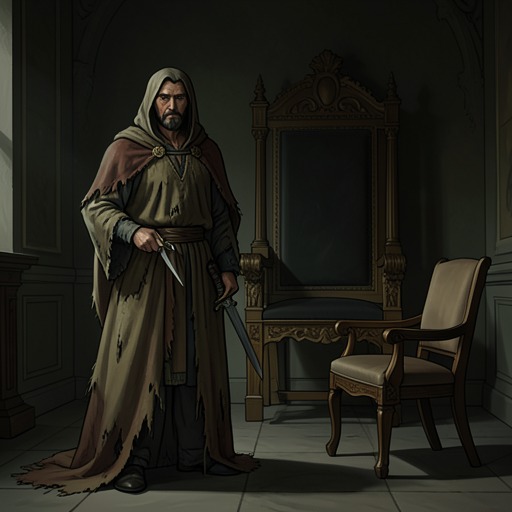
Darilth is introduced as a prince who has come to believe that he may have been cursed. He has passed the age at which the Elder and the King expect him to have found a mate, yet he remains unmarried and without an heir. The pressure damages his pride and turns his frustration outward. He becomes reckless, plundering planets and invading cities, before being exiled to R13, a distant moon of Iovis, where he has spent several decades. Exile therefore functions as both punishment and suspension: Darilth remains the heir, but he is separated from the throne whose continuation depends on his success.
His people, the Drakonaar, are an ancient race that lived for thousands of years on the ice planet Iovis. Their capacity to shapeshift into dragons is itself the result of cross-species ancestry. The first hybrid Drakonaar was born when an earlier Rothgar King mated with the native Dragon Queen; that descendant could assume dragon form and could also convert a mate into a shifter. Darilth thus embodies a history in which royal legitimacy, reproduction, bodily transformation, and interspecies contact are inseparable. His identity is not presented as purely human or purely dragon-like, but as a royal inheritance continually regenerated through hybrid biology.
The greatest burden placed on him is the recovery of the Draco’s Eye, an ancient blue stone with extraordinary healing power. The Eye can heal illness and injury and make its bearer a powerful ruler and protector of Iovis and the surrounding worlds. Its power also carries an opposing possibility: in the wrong hands, it can become an instrument of limitless conquest, planetary destruction, and enslavement. The Eye has remained dormant since the death of the last worthy bearer because that ruler’s mate could not awaken it. Darilth’s search for a true mate is therefore not merely romantic or genealogical. It is a search for the person who can reactivate the political and moral force on which his civilization’s protection depends.
The Search for Ella
A witch once prophesied that Darilth’s true mate would come from another world and would be different even from her own kind. His soldiers search across the Delta Quadrant, but their efforts fail, and the passing years make him doubt the prophecy. The search follows the structure of a quest, yet it is also a test of Darilth’s capacity to distinguish destiny from projection. He is not simply looking for a bride who satisfies royal expectations; he is trying to identify an impossible figure whose difference will confirm the prophecy and unlock the Eye.
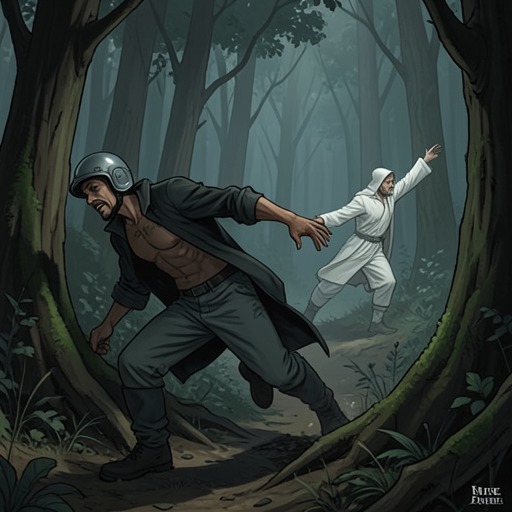
That confirmation arrives on Earth when Darilth observes Ella tending a garden outside a stone-and-brick building. Her stark white skin and ice-blonde hair distinguish her from the humans around her, and her appearance reminds him of the witch’s words. Hidden among the trees nearly a hundred yards away, with his hood drawn down and dark clothing blending into the thicket, he watches rather than approaches. His inner dragon, Mekarth, identifies her as the one: his true mate. The moment gives the prophecy a body, but it does not erase the ethical problem of how Darilth acts on that recognition. He has found the woman he believes fate promised him while she remains unaware of his existence.
The first direct encounter is shaped by danger and concealment. Darilth has placed a force field around the area, and an elderly woman who crosses it is badly injured. Because he cannot heal her, he concludes that he has no choice but to kill her. He then prevents Ella from entering the field, seizes her from behind, pins her against a tree, and uses a translator in her ear to command silence. Her fear is immediate, while his physical response to her scent is intoxicating and involuntary. The scene makes the value shift stark: Darilth experiences recognition and mate-bond certainty, whereas Ella experiences abduction and the loss of control over her body and surroundings.
Darilth takes Ella to a castle-like residence on Iovis, a place where ancient stone architecture coexists with electric lighting and other modern fittings. When she wakes naked beneath the covers, freezing and weak in an unfamiliar room, she understands herself as a captive. Darilth identifies himself as the son of King Rezelith and tells her that she is his mate. He claims that she will soon officially become his bride, presenting the bond as a fact already established by his authority rather than a relationship requiring her consent. The language of destiny and the material reality of captivity remain deliberately tense beside each other.
Royal Conflict and the Question of Freedom
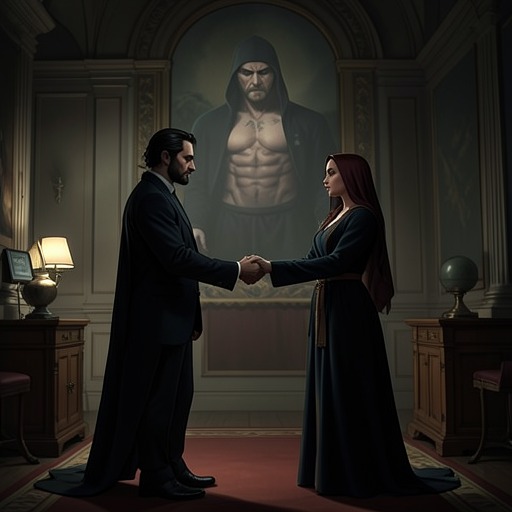
Darilth brings Ella before Lord Rezelith, the King of Rothgar and the Elder of the Drakonaar, in a vast hall of stone columns and arched windows overlooking an icy world. He formally introduces her as the woman destined to be his bride and his true mate. Rezelith responds with contempt because she is human and visibly unlike the women he expects Darilth to choose. The king’s rejection exposes the contradiction at the heart of Darilth’s position: the prince needs an extraordinary outsider to fulfill the prophecy, but the royal order he is meant to inherit regards that outsider as inferior.
Darilth also has to explain the social system into which he has brought Ella. He tells her that his world has no free women; women are either warriors married to men or slaves who serve as concubines. Ella answers that she would rather die than become a slave and asks to be killed before enduring further humiliation. Her refusal forces Darilth to confront the difference between claiming a mate and respecting a person. He offers to make an exception for her, promising to set her free and send her home if she wishes. The offer does not undo the abduction, but it marks a change in his conduct: he begins to place her stated will above the customary entitlement of a royal male.
Ella says that she has no home or family and does not want to return to the convent, where her life was no better than slavery. Darilth then reveals that he must leave Iovis because he remains in exile and asks whether she would prefer to become his wife. The proposal is still made within unequal circumstances—he is a prince, she is isolated, and he controls access to the world she has been taken to—but it is framed as a choice rather than a command. Darilth’s arc consequently turns on an unresolved negotiation between the coercive institutions of his society and the personal relationship he wants to create with Ella.
The Draco’s Eye and Darilth’s Relationships
Darilth’s strongest established bond is with Ella, whom he recognizes as his true mate through both the prophecy and the response of the Draco’s Eye. When Ella asks why he chose her despite the many women available to him, Darilth removes the silver band bearing the large blue stone and slides it onto her wrist. The band contracts to fit her, and the stone glows bright blue. He explains that the object is the Draco’s Eye and that, as heir to the Rothgar throne, he is its bearer; when he first saw Ella on Earth, the stone showed him that she was his destined mate.
The Eye operates as both proof and instrument. Its light validates Darilth’s recognition of Ella, but its deeper significance reaches beyond private certainty. Because only a true mate can awaken it, Ella’s body and identity become linked to the restoration of royal power. That linkage gives her unusual importance in a society that otherwise defines women through marriage, warfare, or concubinage. Darilth’s attraction to her is therefore entangled with dynastic necessity, while Ella’s difference becomes a source of political possibility rather than merely a mark of foreignness.
Darilth’s relationship with Mekarth, his inner dragon, further complicates his identity. Mekarth speaks within him and identifies Ella before Darilth can fully accept the conclusion himself. The inner dragon is not simply a second personality; it represents the animal and inherited force within a prince who must make political decisions through a body capable of transformation. Darilth’s hesitation, observation, desire, and royal duty all unfold alongside this internal dragon consciousness, making his search a negotiation between personal judgment, instinct, and prophecy.
His relationship with Lord Rezelith is defined by succession and rejection. Darilth approaches his father formally, presenting Ella as the destined bride who may secure the future of the throne, but Rezelith responds by belittling both his choice and his judgment. Darilth’s exile means that he cannot simply inherit power through birth; he must prove himself through the mate quest and the recovery of the Eye. His father’s contempt consequently makes the search emotionally personal as well as politically necessary.
Change and Narrative Significance
Darilth begins as a prince who interprets failure as a curse and responds to humiliation through reckless violence. His exile and years of fruitless searching leave him doubtful that the witch’s prophecy will ever be fulfilled. The discovery of Ella changes the direction of his life, but it does not immediately make him morally transformed. He first approaches her through surveillance, force, and abduction, acting as though certainty of destiny grants him entitlement to her presence.
Ella’s resistance becomes the pressure that reshapes him. Her rejection of slavery, her demand for death rather than concubinage, and her admission that the convent offered no real home compel Darilth to see that rescue and captivity can coexist in the same gesture. His promise to free her, followed by his request that she choose whether to become his wife, signals movement away from inherited domination and toward a relationship based at least partly on her expressed preference. The narrative does not erase the imbalance between them; instead, it makes that imbalance the central moral problem of Darilth’s romance.
Darilth also stands at the threshold between restoration and catastrophe. If Ella awakens the Draco’s Eye, he may become the protector his threatened worlds need. If the Eye falls into the wrong hands, the same power can enable invasion, annihilation, and enslavement. His quest therefore gives romantic destiny the scale of planetary politics. The prince’s future depends not only on finding the right woman, but on what kind of ruler he becomes once the power he seeks is restored. Darilth’s significance lies in that unresolved transformation: he is heir, exile, dragon shifter, lover, captor, and potential protector, with each identity pulling the others into question.